Recently, IRENA released a report titled 《All-Day Renewable Energy: The Economics of Reliable Wind and Solar Power》The report provides a robust methodology for assessing and comparing the costs of all-day renewable electricity, while analyzing cost trends, cost drivers, and regional variations in integrated all-day wind, solar, and storage power generation.
The report confirms that the combination of solar, wind, and battery storage is now reliable and capable of providing all-day electricity cost-effectively. In regions with high-quality wind and solar resources, integrated solutions equipped with energy storage can achieve round-the-clock power supply at a cost that is already lower than that of fossil fuel-based generation. Meanwhile, as the penetration of renewable energy in power systems continues to rise, the core challenges of the energy transition are increasingly focused on adequacy and flexibility. To this end, the report introduces the reliable levelized cost of energy (LCOE) as an evaluation benchmark, further confirming that integrated wind-solar-storage solutions are significantly more cost-competitive than fossil fuels under round-the-clock generation conditions.
Battery Storage Costs Down 93%
From a technological perspective, driven by cost reductions in solar, wind, and battery storage systems, reliable costs have fallen rapidly.
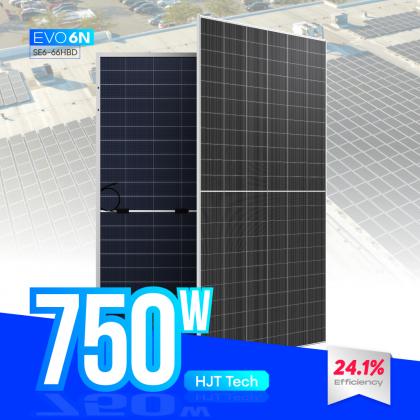
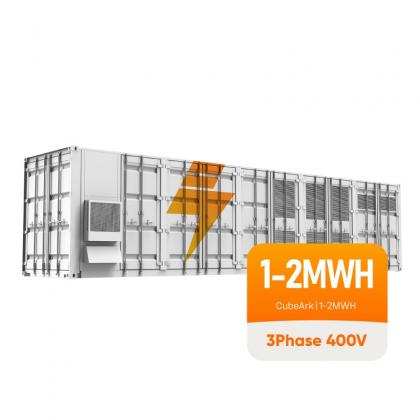
Between 2010 and 2024, solar power costs fell by 87% to $708 per kilowatt; onshore wind power costs fell by 55% to $1,066 per kilowatt. The decline in battery storage costs has been even more dramatic, falling from $2,634 per kilowatt-hour in 2010 to $197 per kilowatt-hour in 2024—a 93% reduction. Recent industry surveys indicate that this downward trend accelerated further in 2025, with turnkey system prices dropping by approximately 30% within a single year to reach an all-time low. Over the next five to ten years, ongoing technological advancements, expanded manufacturing scale, and supply chain maturation are expected to drive further cost reductions for these three technologies.
PV + Storage: $54–$82/MWh
Wind + Storage: $59–$94/MWh
The decline in capital costs has also driven down levelized costs. In regions with high-quality wind and solar resources, the levelized cost of PV systems with storage has fallen from over $100 per MWh in 2020 to $54–82 per MWh in 2025, while the cost of new gas-fired power generation globally exceeds $100 per MWh. Loss-of-power costs are projected to decrease by approximately 30% by 2030 and by about 40% by 2035. By 2035, loss-of-power costs in locations with the best project performance will be below $50 per MWh. Additionally, project construction cycles are shortening; in most markets, projects are typically completed within one to two years after obtaining permits and connecting to the grid—significantly faster than new gas-fired power projects.
Wind power combined with energy storage systems also demonstrates strong competitiveness. IRENA estimates indicate that by 2025, the levelized cost of energy for wind plus storage will be approximately $59 per MWh in Inner Mongolia, China, and between $88 and $94 per MWh in Brazil, Germany, and Australia. By 2030, costs in these markets are projected to fall to approximately $49 to $75 per MWh.
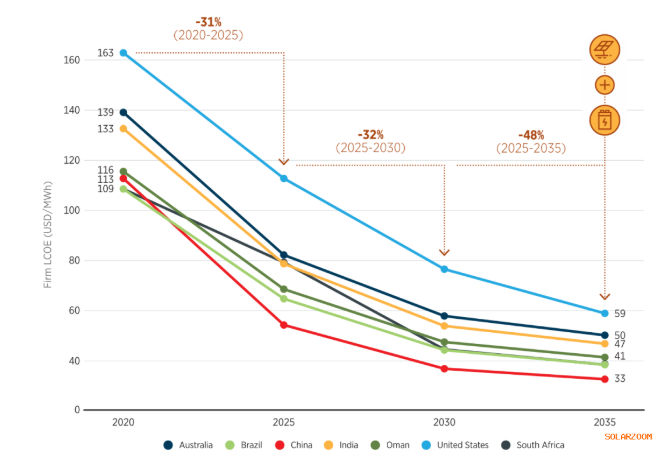
The reliable cost of solar-plus-storage is gradually aligning with that of fossil fuels
From a global perspective, China has set the lower limit for the reliable electricity cost of “solar-plus-storage” worldwide.
IRENA’s simulation of 252 large-scale solar projects commissioned in China in 2024 shows that the vast majority of projects can provide reliable electricity at a cost below $100 per MWh. In the project sample, when the reliability target is 90%, the lowest reliable cost can be as low as $30 per MWh; if the reliability target is raised to 99%, this cost rises to only about $46 per MWh. Even under the highest reliability target, more than half of the projects still fall below the $100 per MWh benchmark. In the United States, the cost of new combined-cycle gas turbines has reached a record high of $102 per MWh—which is roughly equivalent to the cost of reliable solar and wind power generation in resource-rich regions under 90%–95% reliability targets; In Saudi Arabia, PV-plus-storage systems can provide near-continuous power supply at a reliable generation cost of approximately $70/MWh—making PV-plus-storage more cost-competitive than combined-cycle gas power generation, even given the country’s low domestic fossil fuel prices. Furthermore, reliable generation costs in Brazil, India, South Africa, Australia, and the Gulf region are rapidly declining and are gradually converging with those of fossil fuel-based power generation.
Key Factors Affecting Levelized Cost of Energy
The report’s analysis indicates that the key factors influencing the levelized cost of energy include geographic resource conditions, technology costs, and reliability targets.
Among these, resource quality and local weather patterns are the primary determining factors. Meanwhile, as the costs of solar, wind, and battery storage decline, the overall cost range of the system continues to decrease; however, the specific trajectory is influenced by resource quality and financing conditions.
Furthermore, the choice of reliability target is critical: at a moderate reliability level of 80–90% (in high-quality resource areas), hybrid power generation systems can meet demand cost-effectively; once this threshold is exceeded, costs rise non-linearly, with each percentage point increase requiring a disproportionately larger increase in storage or redundancy capacity. Therefore, for most commercial and industrial users, an 80–90% reliability level represents the optimal cost-benefit balance; however, for high-demand users such as data centers, hospitals, and precision manufacturing facilities, dispatchable renewable energy or other backup solutions must be deployed concurrently.
Strategic Value Beyond Cost Advantages
In high-quality resource areas, integrated wind-solar-storage systems can already provide reliable, round-the-clock electricity at a cost no higher than—and in some cases lower than—that of new fossil fuel power plants. However, this does not mean that every power generator must be “reliable”—if sufficient flexibility exists at the transmission grid, energy storage, and demand-side response levels, it is equally possible to support the grid connection of systems with a high proportion of renewable energy. Project-level reliable power plays a more prominent role in three scenarios: when grid access is limited, when users require continuous power supply, or when users urgently need rapid capacity expansion but traditional power sources have excessively long lead times. Integrated wind-solar-storage systems typically take only 1–2 years from approval to operation, far faster than gas-fired power generation, and can utilize existing grid connection points to reduce investment in grid upgrades.
Beyond economic advantages, round-the-clock renewable power also holds strategic value. Recent geopolitical shocks have highlighted that reliance on imported fossil fuels exposes economies to price volatility and supply disruption risks beyond their control. Against this backdrop, renewable electricity—particularly all-weather integrated power systems—offers a distinct solution: because these systems feature localized generation resources, low marginal generation costs, and long-term prices largely decoupled from global commodity markets, they can reliably and flexibly deliver power at predictable and declining costs. This makes them a natural hedge against fossil fuel price volatility for any large electricity consumer.
As generation technologies mature and costs continue to decline, realizing their full potential increasingly depends on supportive policies and strategies. In many countries, electricity markets, grid infrastructure, and procurement policies do not yet fully reflect the value that integrated renewable energy systems can provide. Measures such as market design and reforms that highlight the value of flexibility and reliable power supply will determine how quickly falling renewable generation costs can accelerate the global deployment of renewable energy and effectively reduce countries’ reliance on fossil fuels.



 รองรับเครือข่าย ipv6

 English
 français
 Deutsch
 italiano
 español
 português
 العربية
 日本語
日本語 Polski